Plans for a new library repository move forward
July 16, 2026
A vision 10 years in the making took a critical step forward this week, as the University of Michigan Board of Regents approved the design phase of a library repository project that will serve as a center for the preservation, management, digitization, and distribution of the majority of the U-M Library's physical collection.
One of the world’s largest and most significant collections at a public institution, it encompasses 9 million print volumes, along with ancient papyrus documents; one-of-a-kind archival material; special, rare, and unique maps and manuscripts; artists’ books; a growing archive of playable video games; and more.
The project will ensure that the university's research community has enduring and ready access to these materials, and protects for future generations this substantial portion of the world’s recorded knowledge and creativity.
The purpose-built facility, slated to be located adjacent to US-23 and Geddes Road, will extend the usable lifespan of even the most fragile materials through optimal climate-controlled conditions. It will also streamline the library's rapid delivery of physical materials and digital scans through state-of-the-art shelving infrastructure and improved retrieval practices and workflows.
In addition to housing the majority of the physical collection, the new facility will be a major hub for a wide range of collections-related work. The space will support the work of collections stewardship staff, librarians, and archivists, including metadata creation, inventory management, and conservation. Ultimately it will advance all essential services including user access, digitization, and both physical and digital materials preservation. Together, these services ensure that materials remain findable, accessible, and preserved for future scholarship.
“The work our library employees will do every day in this new space is essential to caring for the collections and making them accessible,” said Donna Hayward, associate dean of libraries. “Just as importantly, it directly supports the university’s research enterprise by ensuring that scholars here and beyond can continue to use these materials for teaching, learning, and discovery.”
The library will continue to maintain a significant browsable collection of materials in campus library buildings, including the Hatcher and Shapiro libraries.
Why a repository?
Currently, millions of volumes and archival holdings are dispersed across 13 campus and nearby locations in a mix of university-owned and leased facilities. None of these provide adequate environmental conditions and all are at or near capacity.
The new facility will protect collection materials of all kinds from many known hazards, including mold, insects, and water. And its proximity — just 5 miles from Central Campus — ensures that the library can continue to deliver requested materials to a campus library or office within a few business days.
Hayward, who has been planning for a solution to the library's shelving crisis for about a decade, said that the problem of managing and sharing the collection from its many disparate and ill-equipped buildings has become increasingly challenging, presenting risks to both the materials and to the people working with them.
The repository project couldn't be more pressing, she said.
"We'll be able to move materials out of buildings that were never equipped for long-term preservation, some of which are deteriorating and becoming unsafe for both the books and the people who retrieve and deliver them," said Hayward.
“It's also a critical first step in a larger plan to renovate the Hatcher and Shapiro libraries to match the evolution of library services.”
The long-term goal is to create more and better library facilities for study, consultation, and engagement, alongside a browseable collection of books.
Dean of Libraries Lisa Carter looks forward to the opportunities to reimagine the library as a place for the campus community, and celebrates the long-term commitment to a collection that has been built over two centuries.
"I can't overstate the important role that the U-M Library has in the global library ecosystem," she said. "It's a mark of excellence that the university is enhancing our capacity to steward the collection while also laying the groundwork for the transformation of our much-in-demand library spaces."
The project is in the early planning and design phase. The Board of Regents will need to approve the final design.
You'll find up-to-date information about the project on the library website.
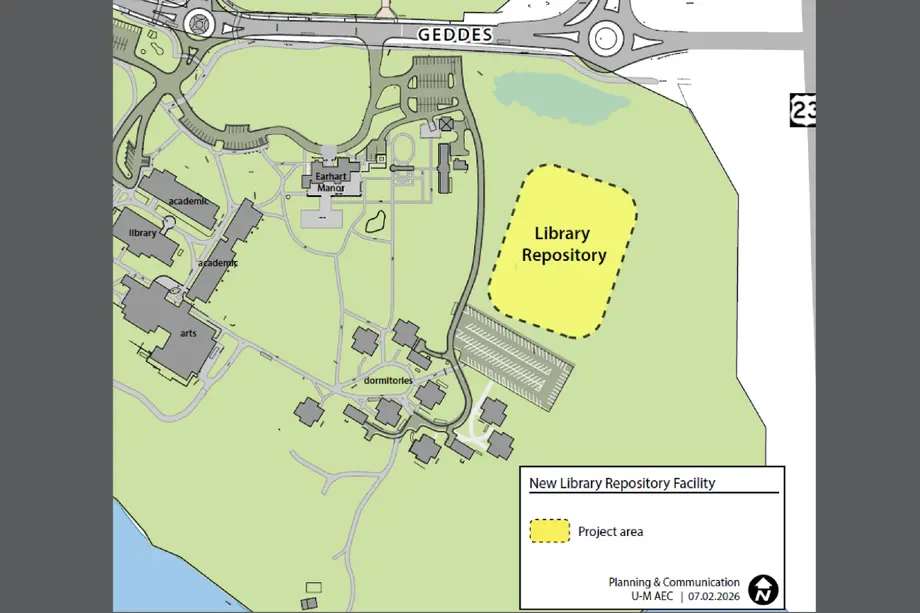
Project area for the new library repository facility.