Book artists trace lineage
March 19, 2026
A visit by three practitioners of Ottoman classical book arts offered the rare opportunity for a look at how contemporary artists learn from their mentors, even those whose works are centuries old.
The artists, calligraphers Dr. Nihad Dukhan and Pablo (Khalid) Casado and Illumination artist Behnaz Karjoo, were part of a panel discussion led by Aisha Imam, director of the Reed Society for the Sacred Arts.
The panel was followed by a viewing of items from the library's Islamic Manuscripts Collection that represent the artistic lineage of the visitors.
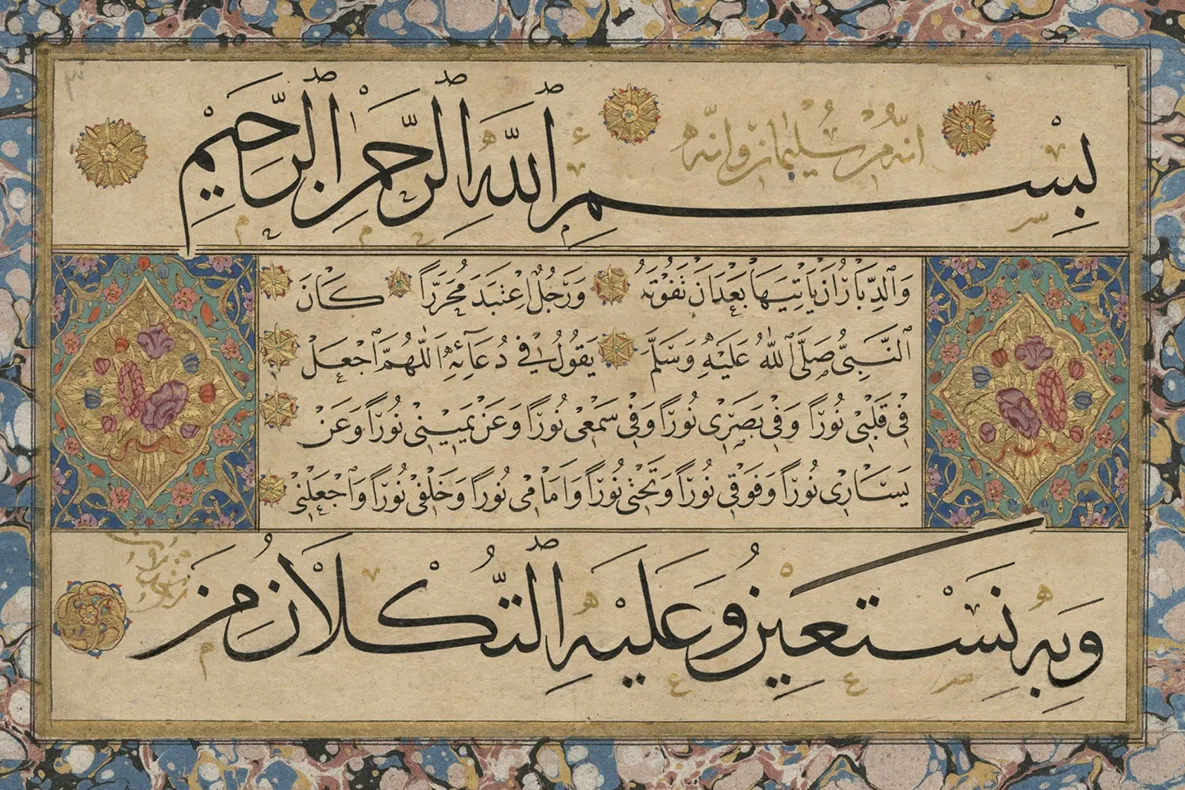
Islamic Manuscripts Curator Evyn Kropf, who will guided the viewing, said. "It's a rare opportunity to witness contemporary artists in dialogue with these early masters, some of whom established the methods and traditions they're carrying forward."
The Islamic Manuscripts Collection holds about 1,100 volumes dating from the 8th to the early 20th century, primarily Arabic, Persian, and Ottoman Turkish. The collection ranks among the largest and most significant such collections in North America, and you can see and download almost all of it in the HathiTrust Digital Library. A number of these Islamic manuscripts are always on display in the Detroit Institute of Arts Islamic World Galleries.
Imam, who founded the Reed Society and who is herself an aspiring calligrapher, says that the apprentice experience is much more than the transmittal of techniques.
She studied under American Arabic calligrapher Mohamed Zakariya, who designed the U.S. postage stamp commemorating Eids. Zakariya is the first Arabic calligrapher in the United States to receive an ijaza, a traditional certificate of mastery that authorizes its holder to transmit their knowledge, and Imam met with him weekly for several years.
“It wasn’t just about writing letters,” she says. “It was conversation, poetry, art references, learning how to see. Your teacher refines your vision.” This realization — that traditional art forms carry deep cultural knowledge, and that this knowledge is best transmitted through relationships — led to her founding the Reed Society, which is dedicated to preserving, nurturing, and shedding light on such traditions and practices.
Book arts practitioners had the chance for a less immersive apprentice experience in two half-day workshops offered during the visit: The Art of Illumination (tazhib) with Behnaz Karjoo and Introduction to the Art of Calligraphy with Khalid Casado.
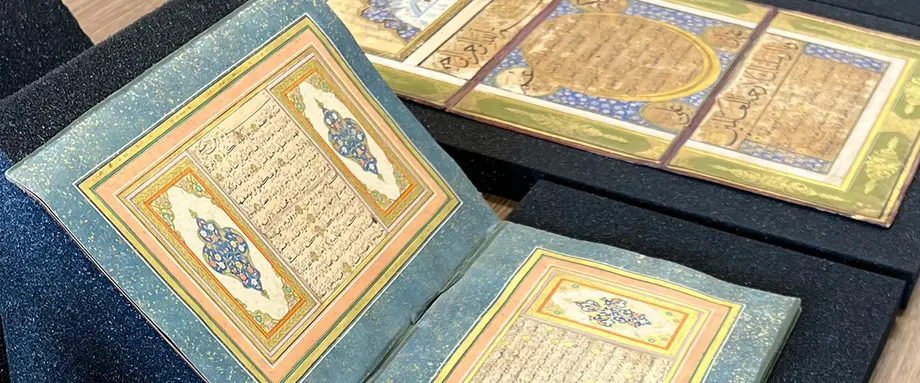
Calligraphic pieces from the Islamic Manuscripts Collection